Understanding how to find y intercept is one of the most important foundational skills in algebra. Whether you’re solving linear equations, graphing functions, analyzing tables, or working with parabolas and rational functions, the y-intercept tells you where a graph crosses the vertical axis. This single value reveals how a function behaves when the independent variable equals zero.
The concept originates from analytic geometry developed by mathematicians such as René Descartes, whose coordinate plane system still forms the backbone of algebra and calculus. Today, learning how to find y intercept is essential for high school algebra, standardized testing, calculus preparation, economics modeling, and even data science.
According to curriculum standards published by National Council of Teachers of Mathematics, understanding intercepts is critical for interpreting linear models and real-world relationships.
Understanding What a Y Intercept Really Means
Before learning how to find y intercept in different forms, it’s crucial to understand what it represents conceptually.
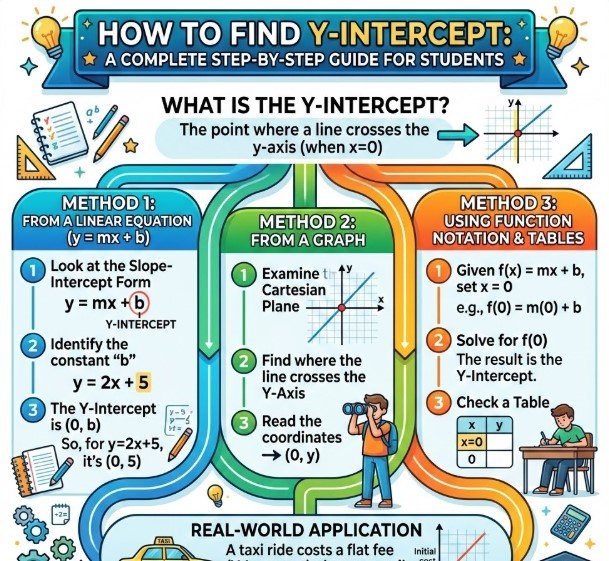
The y-intercept is the point where a graph crosses the y-axis. Mathematically, it occurs when x = 0. This value tells us the starting point of a function in many real-world contexts, such as initial cost, starting height, or baseline measurement.
Why the Y Intercept Matters in Mathematics
• It Represents the Initial Value of a Function
In linear models like y = mx + b, the y-intercept (b) shows the starting output when the input is zero. For example, in cost models, this may represent a fixed fee before usage begins. Understanding how to find y intercept allows students to interpret real-world data accurately.
• It Defines the Vertical Shift of a Graph
If you compare two equations with identical slopes but different intercepts, their graphs are parallel but vertically shifted. This concept becomes important in algebra and calculus when analyzing transformations of functions.
• It Helps Graph Linear Equations Quickly
Once you know how to find y intercept, graphing becomes efficient. Plot the intercept first, then use slope to locate additional points. This method reduces errors significantly.
• It Connects Algebra to Geometry
The y-intercept bridges equation solving and coordinate graphing. It visually demonstrates algebraic relationships on the Cartesian plane.
• It Plays a Role in Statistical Modeling
In regression analysis, the y-intercept represents predicted value when the independent variable equals zero.
• It Forms the Foundation for Advanced Topics
Concepts in calculus, physics, and economics build on intercept understanding.
Also Read:- How to Print from iPhone: The Ultimate Guide for Beginners
How to Find Y Intercept with Slope
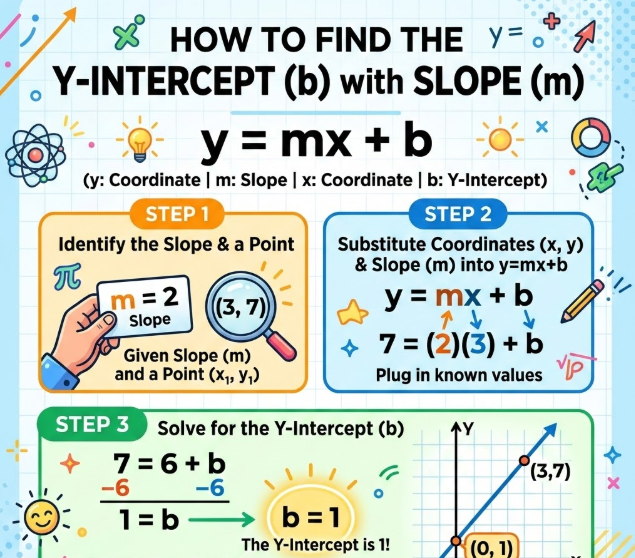
One of the most common scenarios involves slope-intercept form.
The equation of a line is written as:
y = mx + b
Where:
m = slope
b = y-intercept
Step-by-Step Method Using Slope
• Recognize Slope-Intercept Form Immediately
If the equation already appears as y = mx + b, then b is automatically the y-intercept. No additional calculation is needed. This is the fastest way to determine how to find y intercept.
• Convert Standard Form to Slope-Intercept Form
If the equation is Ax + By = C, isolate y by solving algebraically. Once rewritten as y = mx + b, identify b.
• Understand the Role of Zero Substitution
Even if slope is given separately, substitute x = 0 into the equation. The resulting value of y equals the y-intercept.
• Check Units for Real-World Meaning
When applying this concept to applied math problems, confirm that the intercept represents realistic context.
• Verify Graphically for Accuracy
After calculating, graph the equation and ensure it crosses the y-axis at the computed value.
• Practice with Multiple Equations
Mastery comes from repetition using diverse examples.
Also Read:- How to Turn On Apple Watch: Complete Step-by-Step Guide (All Models)
How to Find Y Intercept with Two Points

Sometimes you’re given two coordinate points instead of an equation.
Step-by-Step Using Two Points
• Calculate the Slope First
Use the formula:
m = (y₂ − y₁) / (x₂ − x₁)
This determines the rate of change before solving for intercept.
• Plug into Point-Slope Form
Use one of the given points in y − y₁ = m(x − x₁).
• Convert to Slope-Intercept Form
Solve algebraically to isolate y.
• Identify the Constant Term
The constant value after simplifying is the y-intercept.
• Confirm by Substituting x = 0
Plugging zero into the final equation ensures correctness.
• Double-Check Using Both Points
Substitute both original points to verify equation accuracy.
Also Read:- How to Make a Sticker on iPhone: The Complete 2026 Guide
How to Find Y Intercept on a Table
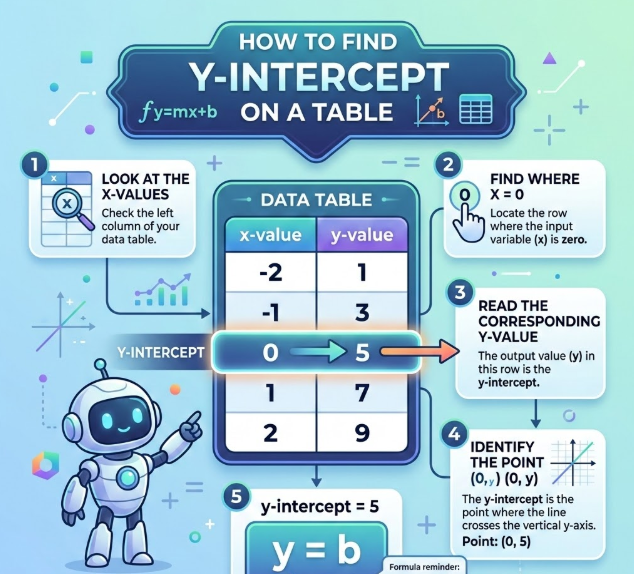
Tables show discrete values instead of equations.
Finding the Intercept from Tabular Data
• Look for x = 0 Directly
If a row shows x = 0, the corresponding y value is the intercept.
• Check for Linear Patterns
If 0 is not listed, determine slope between points to establish equation.
• Use Difference Analysis
If changes in y are constant, the table likely represents a linear function.
• Construct the Equation
Find slope, then use one point to solve for intercept.
• Confirm Using Substitution
Test x = 0 after deriving the equation.
• Interpret Contextually
In applied tables (finance, science), interpret intercept meaning.
Also Read:- How to Draw a Car: The Complete Step-by-Step Drawing Guide for Beginners and Kids
How to Find Y Intercept of a Function
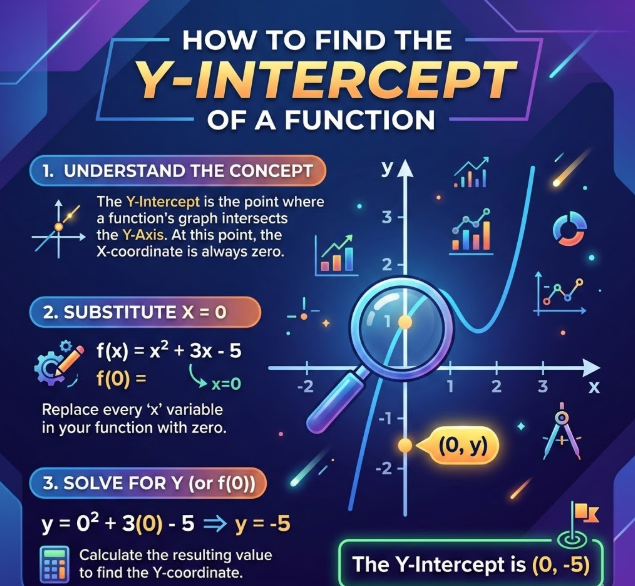
Functions may be linear, quadratic, exponential, or rational.
General Method for Any Function
• Substitute x = 0 into the Function
This universal rule applies to all functions.
• Simplify Carefully
Watch for parentheses, exponents, and fractions.
• Check Domain Restrictions
Ensure x = 0 is allowed in the function.
• Identify Undefined Cases
If denominator becomes zero, no y-intercept exists.
• Graph for Confirmation
Visual verification supports algebraic result.
• Practice Across Function Types
Exposure builds confidence.
Also Read:-How to Cook White Rice: The Complete Step-by-Step Guide for Perfect Results
How to Find Y Intercept on a Graph
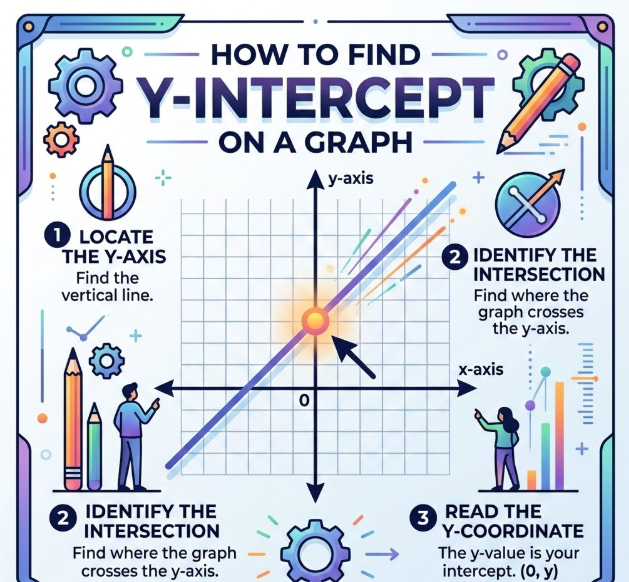
Graphs provide visual solutions.
Visual Identification Strategy
• Locate Where Graph Crosses Y-Axis
The crossing point is the intercept.
• Read Coordinates Precisely
Zoom in if necessary for accuracy.
• Confirm Value is When x = 0
Ensure coordinate aligns with vertical axis.
• Check Scale Units
Incorrect scale reading causes mistakes.
• Compare with Equation if Available
Cross-verification strengthens understanding.
• Practice Using Digital Graphing Tools
Tools like Desmos help visualize instantly.
Also Read:-How to Rent a Car: Comprehensive Guide for Modern Travelers
How to Find Y Intercept of Rational Function
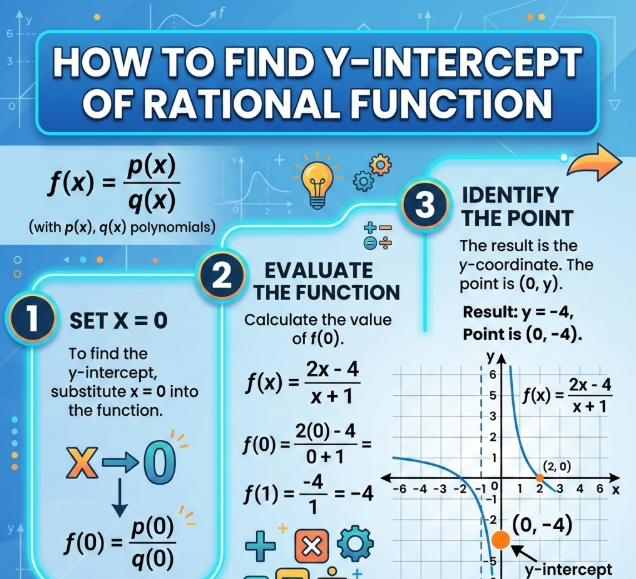
Rational functions involve fractions.
Rational Function Method
• Substitute x = 0
If denominator ≠ 0, compute normally.
• Check for Undefined Value
If denominator equals zero, no y-intercept exists.
• Simplify Before Substitution
Factor expressions when possible.
• Watch for Removable Discontinuities
Some holes still allow intercept calculation.
• Graph to Confirm
Visual aids reveal asymptotes.
• Practice Multiple Examples
Exposure clarifies edge cases.
Also Read:- How to Make Slime: The Ultimate DIY Slime Guide for Beginners and Experts
How to Find Y Intercept of Parabola
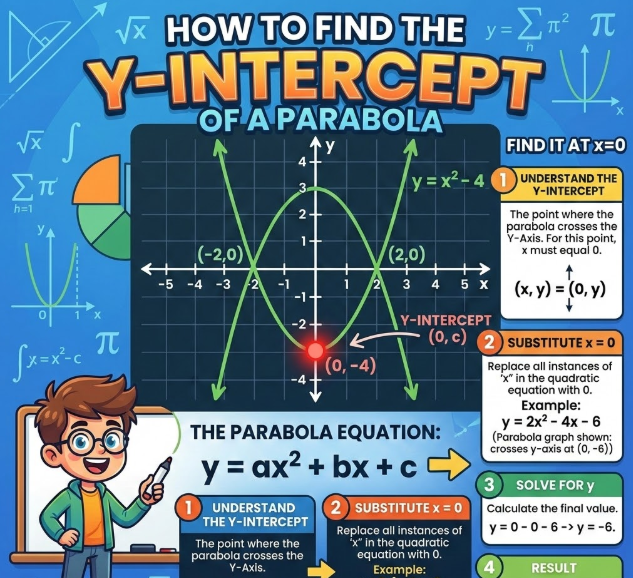
Quadratic equations are written as y = ax² + bx + c.
Parabola Intercept Strategy
• Recognize Standard Form Immediately
In y = ax² + bx + c, the y-intercept equals c.
• Substitute x = 0 to Confirm
This eliminates squared and linear terms.
• Interpret Graphically
Plotting shows vertical crossing.
• Understand Relationship to Vertex
Intercept differs from vertex.
• Check Units in Word Problems
Context matters in applied problems.
• Practice Factored and Vertex Forms
Convert forms to standard to find intercept.
Also Read:- How to Strip Paint from Wood: The Complete Expert Guide for Safe, Effective Results
Conclusion
Learning how to find y intercept is a foundational algebra skill that applies across linear equations, tables, graphs, rational functions, and parabolas. Whether you’re solving equations using slope, calculating from two points, interpreting data tables, or analyzing advanced functions, the rule remains consistent:
Set x = 0.
With consistent practice and conceptual understanding, finding the y-intercept becomes automatic and intuitive — preparing you for higher mathematics and real-world problem solving.
FAQs
Is the y-intercept always where x equals zero?
Yes. By definition, the y-intercept occurs when x = 0.
Can a function have no y-intercept?
Yes. Rational functions may not have one if undefined at x = 0.
Is the y-intercept always positive?
No. It can be positive, negative, or zero.
How is y-intercept different from x-intercept?
Y-intercept occurs at x = 0; x-intercept occurs when y = 0.
Why is this important for exams?
Intercept identification is frequently tested in algebra and SAT-style exams.
For More Visit Alaikas.com